The Rock Islands Southern Lagoon consists of numerous large and small forested limestone islands, scattered within a marine lagoon protected by a barrier reef. The property lies within Koror State, immediately to the south of Palau's main volcanic island Babeldaob in the western Pacific Ocean. The living paradise Palau rock islands inscribed as world heritage this year. Rock Islands Southern Lagoon covers 100,200 ha and includes 445 uninhabited limestone islands of volcanic origin. Many of them display unique mushroom-like shapes in turquoise lagoons surrounded by coral reefs.
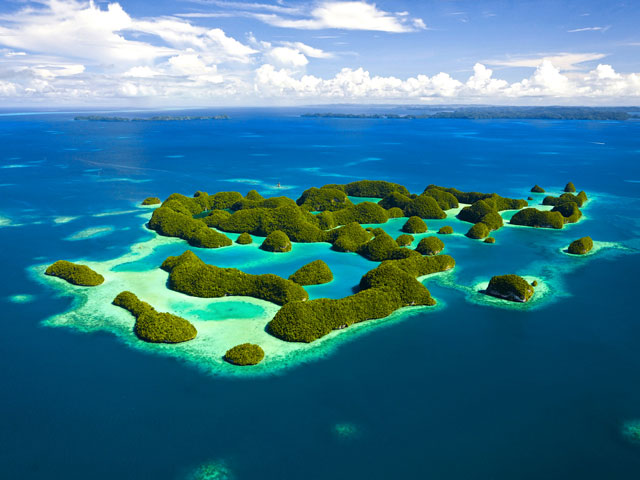 |
| Palau Southern Lagoon Islands |
This is for side heading
 Fortifications on the Caribbean Side of Panama is a magnificent examples of 17th- and 18th-century military architecture, these Panamanian forts on the Caribbean coast form part of the defense system built by the Spanish Crown to protect transatlantic trade. The group of 17th- and 18th-century fortifications, the historic sites of Portobelo and San Lorenzo, are outstanding examples of Spanish colonial military architecture of this period. These fortifications, imbued with history, are a magnificent example of Spanish military architecture, located in a natural setting of great beauty.
 |
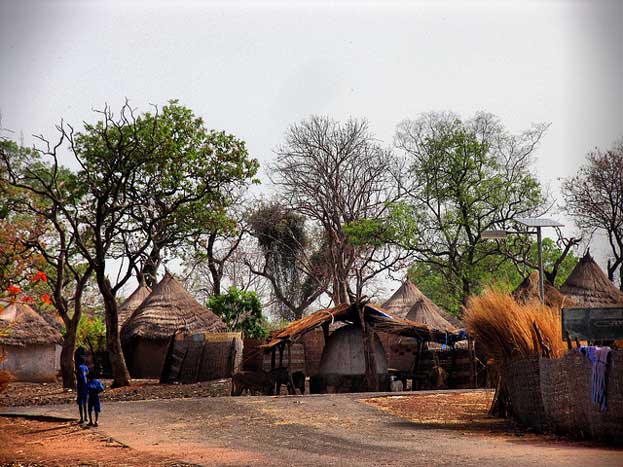
| Niokolo Koba National Park Entrance Village |
Read More... Browse Gallery
 Continent: Asia
Country: Israel (Palestine)
Category: Danger List Site
Criterion: (IV)(VI)
Date of Inscription: 2012
This is for side heading
Continent: AsiaCountry: Israel (Palestine)
Category: Danger List Site
Criterion: (IV)(VI)
Date of Inscription: 2012
Continent: Asia
Country: Israel (Palestine)
Category: Danger List Site
Criterion: (IV)(VI)
Date of Inscription: 2012
This is for side heading
Fortifications on the Caribbean Side of Panama is a magnificent examples of 17th- and 18th-century military architecture, these Panamanian forts on the Caribbean coast form part of the defense system built by the Spanish Crown to protect transatlantic trade. The group of 17th- and 18th-century fortifications, the historic sites of Reportorial and San Lorenzo, are outstanding examples of Spanish colonial military architecture of this period.
These fortifications, imbued with history, are a magnificent example of Spanish military architecture, located in a natural setting of great beauty. Antonelli's Spanish military architecture characterizes the first construction period (1596-99) and the neoclassical style of Salas and Hernandez (1753-60) dominated afterwards.
This is for side heading
Fortifications on the Caribbean Side of Panama is a magnificent examples of 17th- and 18th-century military architecture, these Panamanian forts on the Caribbean coast form part of the defense system built by the Spanish Crown to protect transatlantic trade. The group of 17th- and 18th-century fortifications, the historic sites of Reportorial and San Lorenzo, are outstanding examples of Spanish colonial military architecture of this period.
These fortifications, imbued with history, are a magnificent example of Spanish military architecture, located in a natural setting of great beauty. Antonelli's Spanish military architecture characterizes the first construction period (1596-99) and the neoclassical style of Salas and Hernandez (1753-60) dominated afterwards.
|
| Palau Southern Lagoon Islands |
Fortifications on the Caribbean Side of Panama is a magnificent.
Golden Words of the Article
You have to believe in yourself, that is the secret. Even when I was in an orphanage, when I was roaming the street, Trying to find enough to eat, even then I thought of myself as the greatest actor in the world. I had to feel, the exuberance that comes from utter confidence in myself. Without it, you go down to defeat.
You have read this article Argentina /
Asia Heritage /
Bangladesh /
Brunei /
Cambodia /
Cities /
Czech Republic
with the title Bangladesh. You can bookmark this page URL https://tiffanyeatworld.blogspot.com/2012/08/front-view-first.html. Thanks!