You have read this article Architecture /
Cityscape /
France /
Paris
with the title France. You can bookmark this page URL https://tiffanyeatworld.blogspot.com/2012/06/paris-louvre-glass-pyramid-hd-wallpapers.html. Thanks!
Home » Post Category France
Showing posts with label France. Show all posts
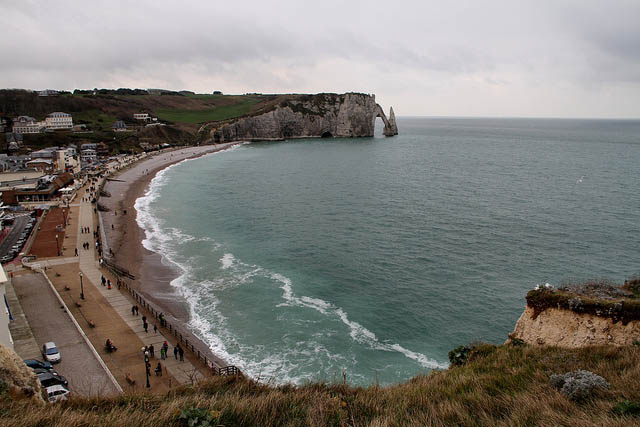
Etretat Cliffs
Étretat is a commune in the Seine-Maritime department in the Haute-Normandie region in northern France. It is a tourist and farming town situated 32 km northeast of Le Havre, at the junction of the D940, D11 and D139 roads. It's located on the coast of the Pays de Caux area. Étretat is best known for its cliffs, including 3 natural arches and the pointed "needle". These cliffs and the associated resort beach attracted artists including Eugène Boudin, Gustave Courbet and Claude Monet, and were featured prominently in the 1909 Arsène Lupin novel The Hollow Needle by Maurice Leblanc. Two of the three famous arches seen from the town are the Porte d'Aval, and the Porte d'Amont. The Manneporte is the third and the biggest one which cannot be seen from the town. The GR 21 long-distance hiking path passes through the town.
![]() |
| The Cliffs at Etretat |
Text source:- Wikipedia. Images are copyrighted by their owners. Found any copyright issue, contact the administrator immediately. Report it now!
You have read this article Cliffs /
Europe /
France /
Traveller Choice
with the title France. You can bookmark this page URL https://tiffanyeatworld.blogspot.com/2012/03/etretat-cliffs.html. Thanks!
Bora Bora Island
Bora Bora is an island in the Leeward group of the Society Islands of French Polynesia, an overseas collectivity of France in the Pacific Ocean. The original name of the island in the Tahitian language might be better rendered as Pora Pora, meaning "First Born"; an early transcription found in 18th- and 19th-century accounts, is Bolabolla or Bollabolla. The island, located about 230 kilometres northwest of Papeete, is surrounded by a lagoon and a barrier reef. In the center of the island are the remnants of an extinct volcano rising to two peaks, Mount Pahia and Mount Otemanu, the highest point at 2,385 feet.
![]() |
| The Bora Bora Island |
Bora Bora is a major international tourist destination, famous for its aqua-centric luxury resorts. The island is served by Bora Bora Airport on Motu Mete in the north, with Air Tahiti providing daily flights to and from Papeete on Tahiti. The major settlement, Vaitape is on the western side of the main island, opposite the main channel into the lagoon. Produce of the island is mostly limited to what can be obtained from the sea and the plentiful coconut trees, which were historically of economic importance for copra. According to a census performed in 2008, the permanent population of Bora Bora is 8,880.
Text source:- Wikipedia. Images are copyrighted by Woodenship, Drangegato88, James and Esther, Maribethlock, Dreamtimes, Nick Friend and Chad Dustin. Found any copyright issue, contact the administrator immediately. Report it now!
You have read this article Beaches /
Europe /
France /
Holiday Destinations /
Islands /
Traveller Choice
with the title France. You can bookmark this page URL https://tiffanyeatworld.blogspot.com/2012/02/bora-bora-island.html. Thanks!
Chateau Gaillard Ruined Castle
Château Gaillard is a ruined medieval castle, located 90 m above the commune of Les Andelys overlooking the River Seine, in the Eure département of historical Normandy, now Upper Normandy, France. It is located some 95 kilometres north-west of Paris and 40 kilometres from Rouen. Construction began in 1196 under the auspices of Richard the Lionheart, who was simultaneously King of England and feudal Duke of Normandy. The castle was expensive to build, but the majority of the work was done in an unusually short time. It took just two years, and at the same time the town of Petit Andely was constructed. Château Gaillard has a complex and advanced design, and uses early principles of concentric fortification; it was also one of the earliest European castles to use machicolations. The castle consists of three enclosures separated by dry moats, with a keep in the inner enclosure. The castle ruins are listed as a monument historique by the French Ministry of Culture. The inner bailey is open to the public from March to November, and the outer baileys are open all year.
![]() |
| Château Gaillard Ruined Castle |
Text source:- Wikipedia. Images are copyrighted by their owners. Found any copyright issue, contact the administrator immediately. Report it now!
You have read this article Castles /
Europe /
France
with the title France. You can bookmark this page URL https://tiffanyeatworld.blogspot.com/2012/01/chateau-gaillard-ruined-castle.html. Thanks!
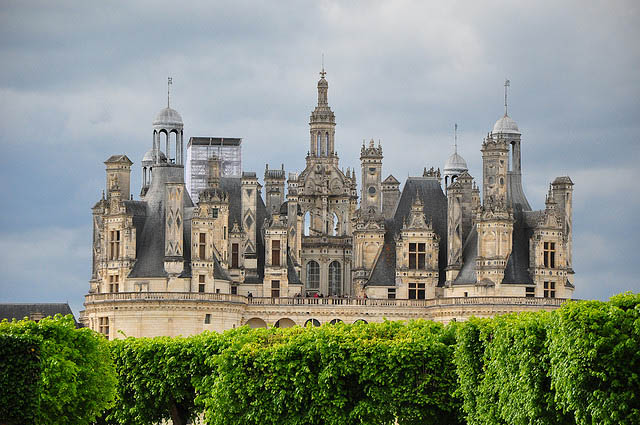
Chateau de Chenonceau
The Chateau de Chenonceau is a manor house near the small village of Chenonceaux, in the Indre-et-Loire département of the Loire Valley in France. It was built on the site of an old mill on the River Cher, sometime before its first mention in writing in the 11th century. The current manor was designed by the French Renaissance architect Philibert Delorme.
![]() |
| Chateau de Chenonceau |
The original second edition manor was torched in 1412 to punish owner Jean Marques for an act of sedition. He rebuilt a castle and fortified mill on the site in the 1430s. Subsequently, his indebted heir Pierre Marques sold the castle to Thomas Bohier, Chamberlain for King Charles VIII of France in 1513. Bohier destroyed the existing castle and built an entirely new residence between 1515 and 1521; the work was sometimes overseen by his wife Katherine Briconnet, who delighted in hosting French nobility, including King Francis I on two occasions.
Eventually, the chateau was seized from Bohier's son by King Francis I of France for unpaid debts to the Crown; after Francis' death in 1547, Henry II offered the chateau as a gift to his mistress, Diane de Poitiers, who became fervently attached to the chateau along the river. She would have the arched bridge constructed, joining the château to its opposite bank. She then oversaw the planting of extensive flower and vegetable gardens along with a variety of fruit trees. Set along the banks of the river, but buttressed from flooding by stone terraces, the exquisite gardens were laid out in four triangles.
Diane de Poitiers was the unquestioned mistress of the castle, but ownership remained with the crown until 1555, when years of delicate legal maneuvers finally yielded possession to her. However, after King Henry II died in 1559, his strong-willed widow and Regent Catherine de' Medici had Diane expelled. Because the estate no longer belonged to the crown, she could not seize it outright, but forced Diane to exchange it for the Château Chaumont. Queen Catherine then made Chenonceau her own favorite residence, adding a new series of gardens.
Text source:- Wikipedia. Images are copyrighted by their owners. Found any copyright issue, contact the administrator immediately. Report it now!
You have read this article Europe /
France /
Palace
with the title France. You can bookmark this page URL https://tiffanyeatworld.blogspot.com/2012/01/chateau-de-chenonceau.html. Thanks!
Subscribe to:
Posts (Atom)