An immense mausoleum of white marble, built in Agra between 1631 and 1648 by order of the Mughal emperor Shah Jahan in memory of his favourite wife, the Taj Mahal is the jewel of Muslim art in India and one of the universally admired masterpieces of the world's heritage.
 |
| Taj Mahal |
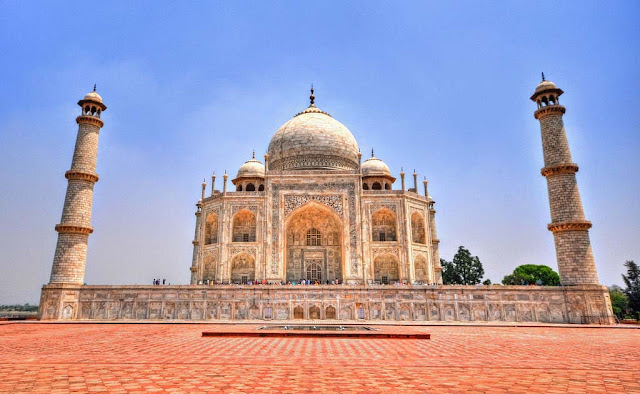
The Taj Mahal, an immense mausoleum of white marble, built in Agra between 1631 and 1648 by order of the Mughal Emperor Shah Jahan, is the jewel of Muslim art in India and one of the universally admired masterpieces of the world's heritage. It no doubt partially owes its renown to the moving circumstances of its construction. Shah Jahan, in order to perpetuate the memory of his favourite wife, Mumtaz Mahal, who died in 1631, had this funerary mosque built. The monument, begun in 1632, was finished in 1648; unverified but nonetheless, tenacious, legends attribute its construction to an international team of several thousands of masons, marble workers, mosaicists and decorators working under the orders of the architect of the emperor, Ustad Ahmad Lahori.

Situated on the right bank of the Yamuna in a vast Mogul garden of some 17 ha, this funerary monument, bounded by four isolated minarets, reigns with its octagonal structure capped by a bulbous dome through the criss-cross of open perspectives offered by alleys or basins of water. The rigour of a perfect elevation of astonishing graphic purity is disguised and almost contradicted by the scintillation of a fairy-like decor where the white marble, the main building material, brings out and scintillates the floral arabesques, the decorative bands, and the calligraphic inscriptions which are incrusted in polychromatic pietra dura. The materials were brought in from all over India and central Asia and white Makrana marble from Jodhpur. Precious stones for the inlay came from Baghdad, Punjab, Egypt, Russia, Golconda, China, Afghanistan, Ceylon, Indian Ocean and Persia. The unique Mughal style combines elements and styles of Persian, Central Asian and Islamic architecture.

The Darwaza, the majestic main gateway, is a large three-storey red sandstone structure, completed in 1648, with an octagonal central chamber with a vaulted roof and with smaller rooms on each side. The gateway consists of lofty central arch with two-storeyed wings on either side. The walls are inscribed with verses from the Qu'ran in Arabic in black calligraphy. The small domed pavilions on top are Hindu in style and signify royalty. The gate was originally lined with silver, now replaced with copper, and decorated with 1,000 nails whose heads were contemporary silver coins.

The Bageecha, the ornamental gardens through which the paths lead, are planned along classical Mughal char bagh style. Two marble canals studded with fountains, lined with cypress trees emanating from the central, raised pool cross in the centre of the garden, dividing it into four equal squares. In each square there are 16 flower beds, making a total of 64 with around 400 plants in each bed. The feature to be noted is that the garden is laid out in such a way as to maintain perfect symmetry. The channels, with a perfect reflection of the Taj, used to be stocked with colourful fish and the gardens with beautiful birds.

The Taj Mahal itself, situated in the north end of the garden, stands on two bases, one of sandstone and above it a square platform worked into a black and white chequerboard design and topped by a huge blue-veined white marble terrace, on each corner there are four minarets. On the east and west sides of the tomb are identical red sandstone buildings. On the west is the masjid (mosque), which sanctifies the area and provides a place of worship. On the other sides is the jawab, which cannot be used for prayer as it faces away from Mecca. The rauza, the central structure or the mausoleum on the platform, is square with bevelled corners. Each corner has small domes while in the centre is the main double dome topped by a brass finial. The main chamber inside is octagonal with a high domed ceiling. This chamber contains false tombs of Mumtaz and Shah Jahan, laid to rest in precise duplicates in a. Both tombs are exquisitely inlaid and decorated with precious stones, the finest in Agra.

The Taj Mahal's pure white marble shimmers silver in the moonlight, glows softly pink at dawn, and at close of day reflects the fiery tints of the setting Sun. From an octagonal tower in the Agra Fort across the River Yamuna, Shah Jahan spent his last days as a prisoner of his son and usurper to the empire, Aurangzeb, gazing at the tomb of his beloved Mumtaz.
Text source:- Wikipedia. Images are copyrighted by their owners. Found any copyright issue, contact the administrator immediately. Report it now!